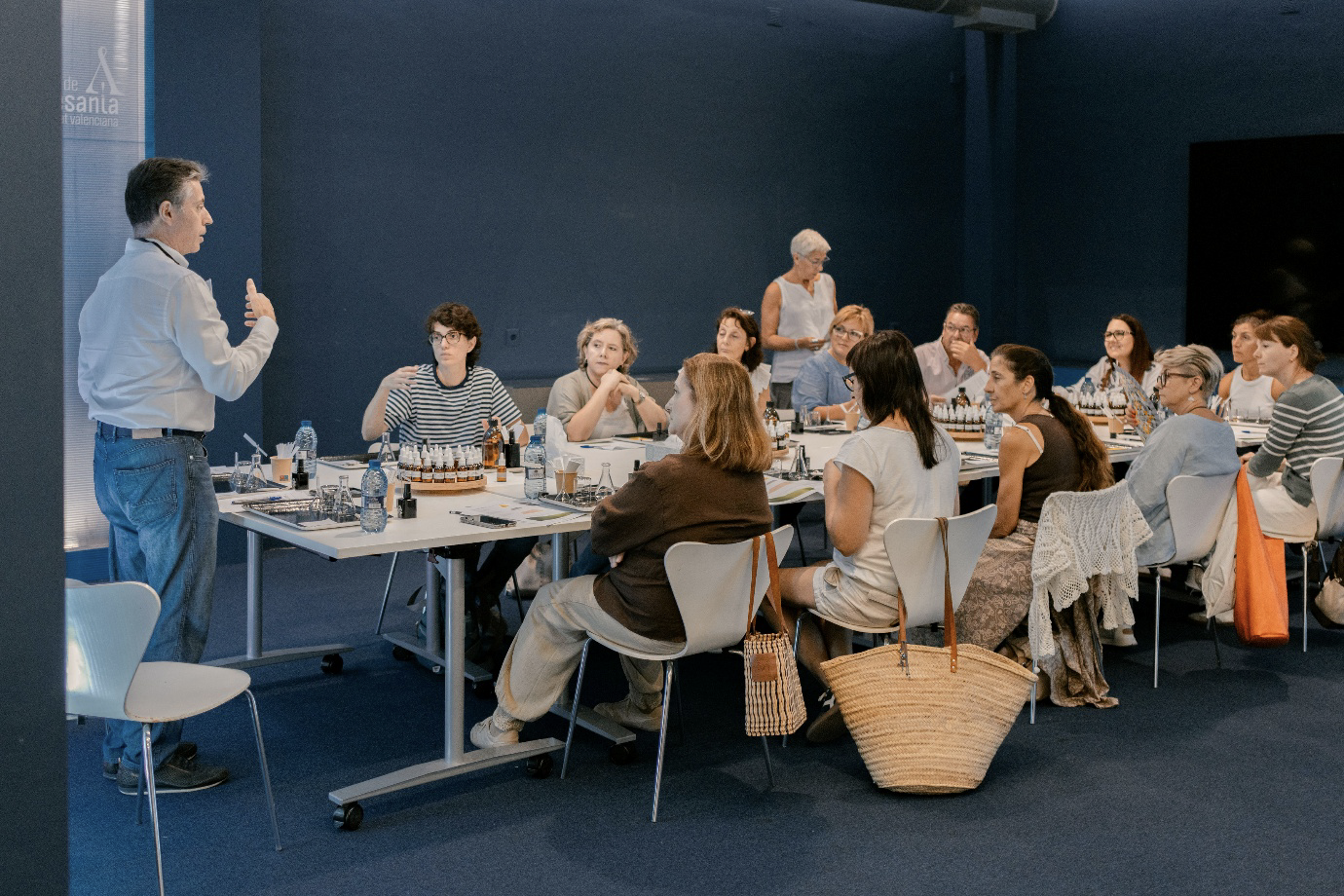
The fourteen workshop participants at the Centre for Crafts of the Valencian Community.
Breathe in who you are. With this idea, we opened our Olfactory Creation Workshop on Friday, 18 September, at the Centre for Crafts of the Valencian Community, right in the heart of Valencia. Over three hours, from 3 pm to 6 pm, fourteen people put their phones and their busy schedules aside to do something we rarely take the time to do: smell mindfully. By the end of the afternoon, everyone went home with a bottle of perfume that had not existed that morning and that no one else in the world owns.
An afternoon of learning how to smell
An essential oil is a highly concentrated natural raw material: a single drop can represent several kilograms of plant material. That is why we started with the basics: how to smell (always using a paper scent strip, never directly from the bottle), how to count the drops, and why it is a good idea to step outside from time to time and breathe neutral air to give the nose a rest.
Christophe Morote, founder of Natural SHUI, then introduced the tool at the heart of the perfumer’s craft: the olfactory pyramid.
- Top notes (20–30%): the first scents we perceive. Citrus and fresh notes provide the initial lift but evaporate within the first fifteen minutes.
- Heart notes (40–50%): flowers and spices. They give the composition its character and are what people recognise as “your perfume”.
- Base notes (25–35%): woods and resins. They provide depth and lasting memories; they also help anchor the other notes and extend the fragrance’s longevity.
A perfume does not reveal itself all at once: it unfolds over time. Composing one means distributing the drops across these three stages.
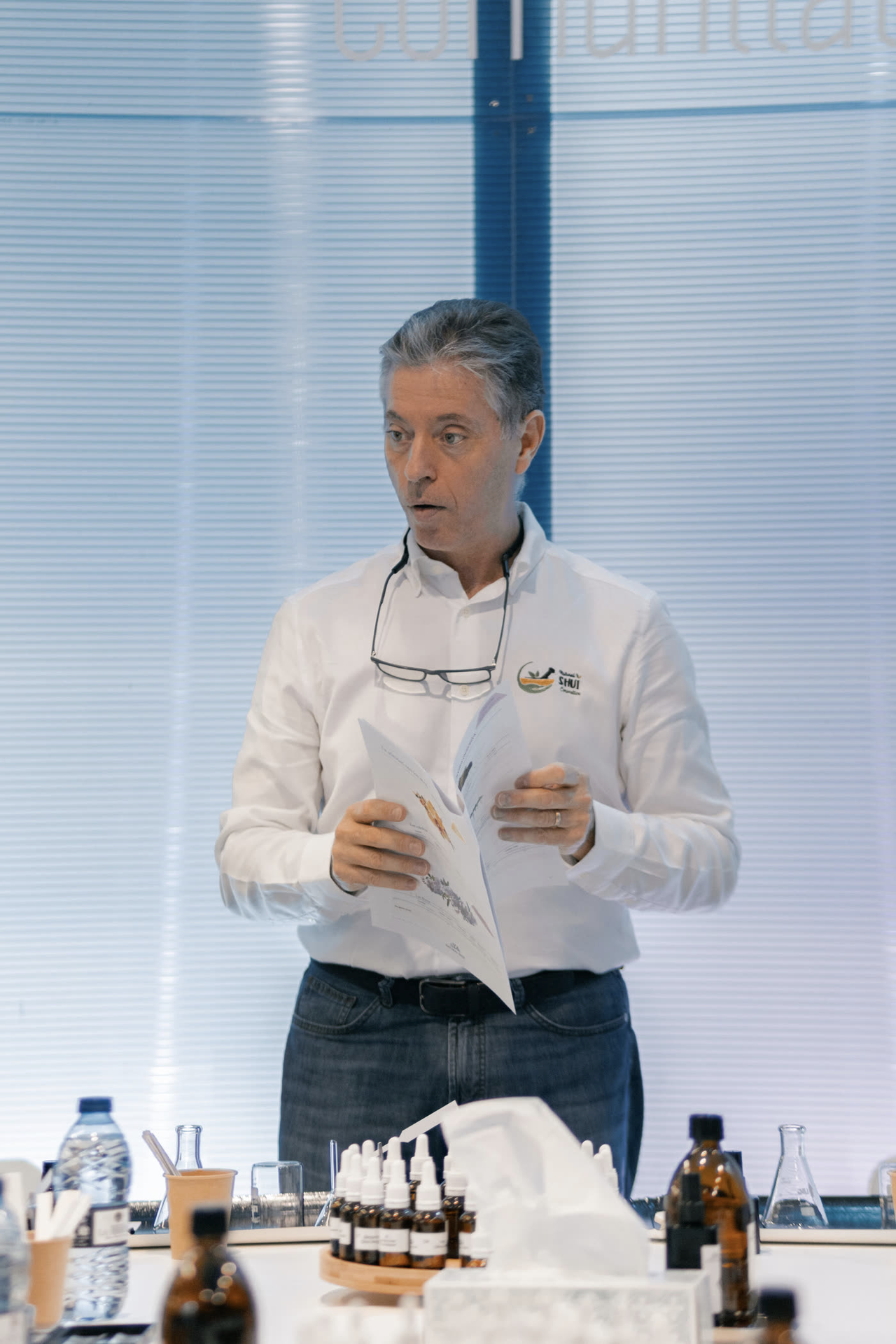
Christophe Morote explaining the olfactory pyramid.
Seven botanical families on the table
One scent strip at a time, each participant explored a palette of more than thirty natural raw materials, organised into seven families:
- Citrus: lemon, bergamot, sweet orange and yuzu.
- Flowers: lavender, orange blossom/neroli, ylang-ylang, jasmine, champaca and Tahitian gardenia (tiare flower).
- Conifers: silver fir, Siberian fir and black spruce.
- Leaves: eucalyptus, rosemary, mint, petitgrain, geranium and patchouli.
- Spices: cardamom, black pepper, ginger and cinnamon leaf.
- Woods: cedarwood, vetiver, sandalwood and our own Shui wood.
- Resins and balsams: frankincense, benzoin, copaiba, vanilla, Tolu balsam and oakmoss.
Two moments always come as a surprise. The first is smelling orange blossom, petitgrain and bitter orange one after another. All three come from the same tree, the bitter orange tree—its flower, leaf and fruit—yet they occupy different places in the olfactory pyramid. The scent does not depend solely on the plant, but on the part that is distilled. The second is placing a sandalwood strip next to a lavender strip. You do not smell the sum of the two; a third scent emerges. That is an accord, and it is precisely what perfumers aim to create.
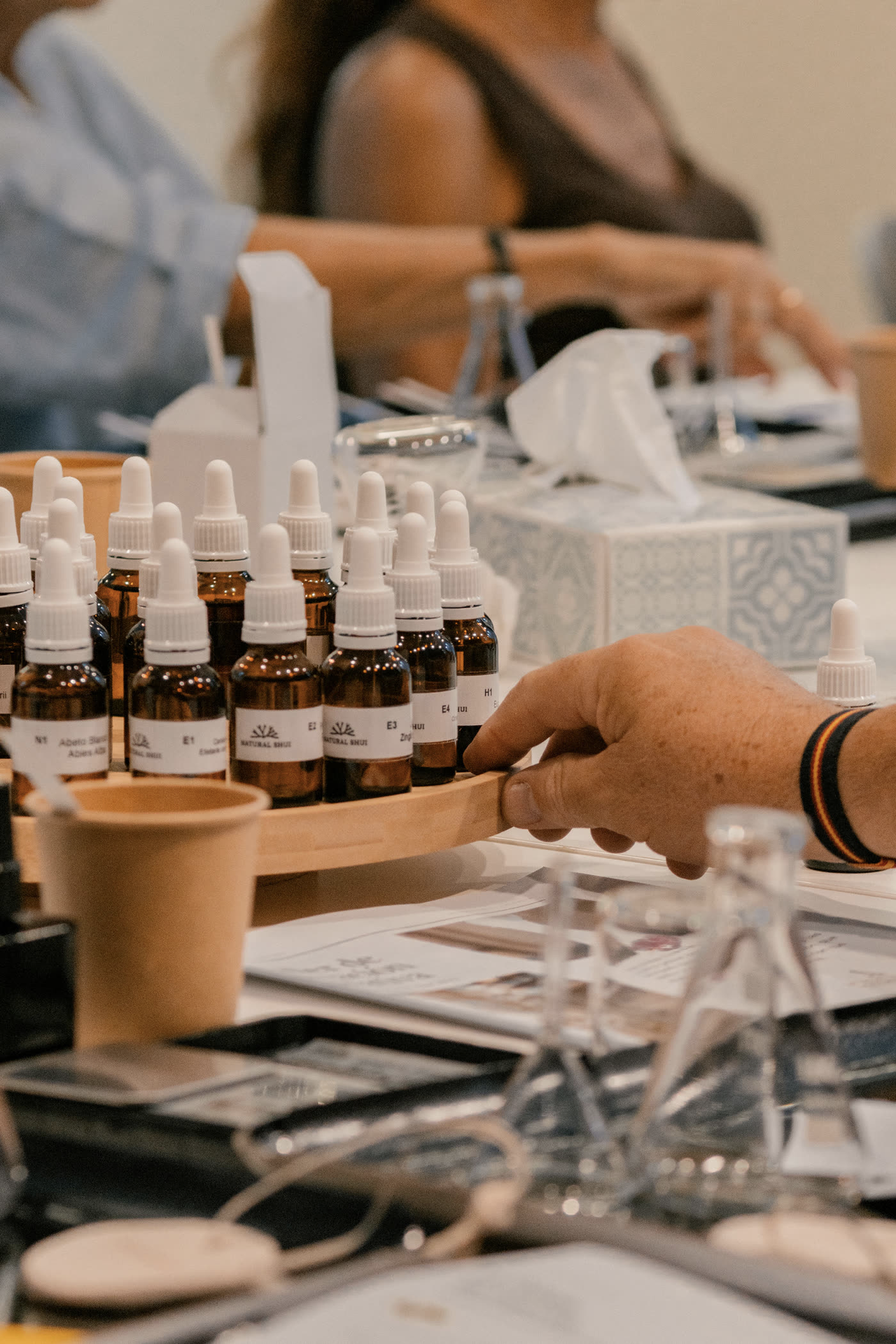
The natural essential oil palette at each workstation.
The Natural SHUI method: from memory to formula
The workshop followed a method developed by Christophe Morote, designed to help anyone, even without previous perfumery experience, create a perfume with meaning. Its starting point is not technique, but each person's olfactory memories.
Step one: smell and remember. As they explored the seven families, participants noted which oils they liked and disliked, and, above all, what each scent brought to mind. A citrus note that takes them back to a childhood summer, a lavender scent that recalls a grandmother’s home, a wood that evokes a walk through the forest… The method draws on oils that awaken positive memories, because these are the scents people will want to experience again.
Step two: choose an intention. Before creating their formula, each participant asked themselves: What do I want to feel when I wear this perfume? The method offers eight possible intentions:
Calm · Serenity · Evening ritual · Confidence · Concentration · Creativity · Joy · Sensuality
Step three: connect memory with intention. The workshop booklet links each essential oil to the intentions associated with it, whether through documented properties or traditional uses. By comparing this information with their list of oils associated with “good memories”, each participant created a personal selection: oils they enjoy, that evoke something positive and that match the feeling they want to cultivate. With this selection ready, it was time to formulate.
Then came the most hands-on part: building from the bottom up. First the base notes, then the heart notes and, finally, the top notes. Drop by drop, counting aloud and recording every addition on the formula sheet, because without it, there is no way to reproduce the blend. The workshop rules were clear: a maximum of eight oils and seventy drops. A smaller number of carefully chosen oils will always smell better than too many crowded together. In fact, the most memorable compositions often contain between four and six oils.
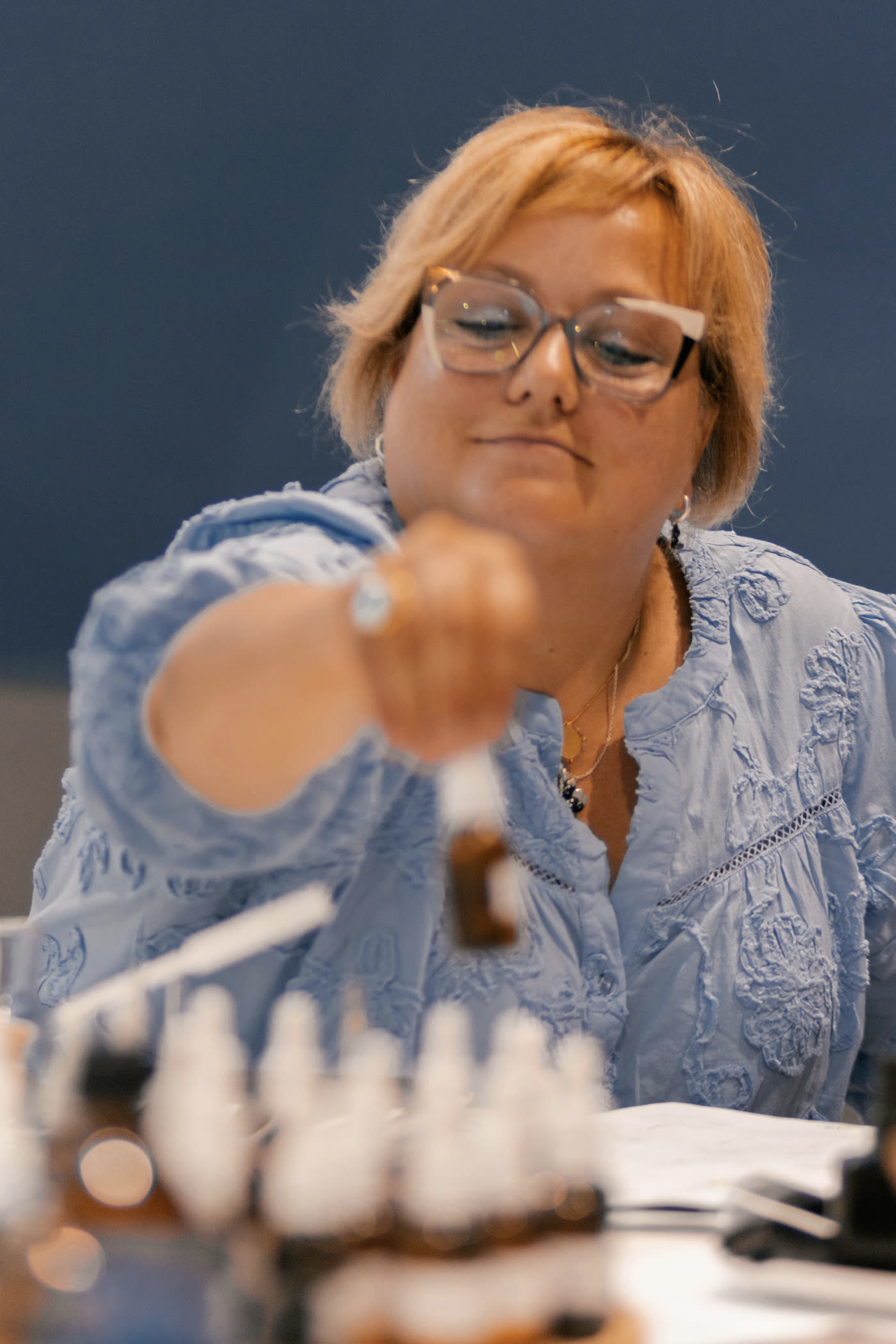
Drop by drop: this is how a perfume takes shape.
Fourteen different perfumes
The loveliest part of the afternoon was discovering that, with the same palette and the same method, no two perfumes turned out alike. Some compositions were bright and citrusy, others enveloping and woody, and others designed for the end of the day. Each bottle was labelled with the name its creator had chosen for their blend.
And the process does not end at the workshop: a composition needs seven to fifteen days of resting in the dark so that the notes can blend harmoniously. What you smell on the first day is not what you will smell a week later. That is why each participant took home a small olfactory journal to record how their perfume develops on days 3, 7, 15 and 30.
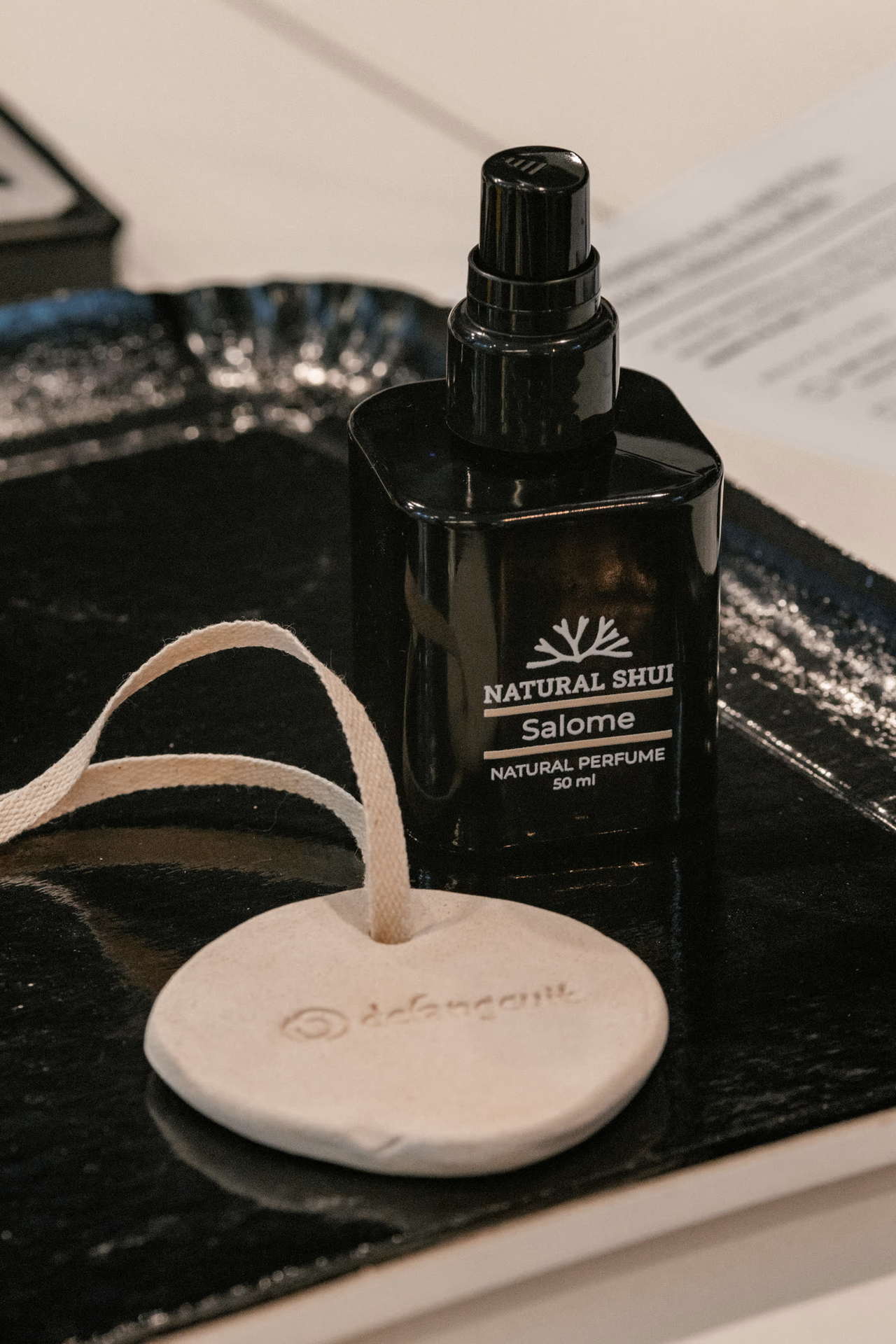
A natural perfume with a name of its own.
Naturally, and safely
At Natural SHUI, we work with natural ingredients, and that is precisely why we handle them with care and respect. Safety was also part of the workshop: perform a patch test in the crook of the elbow 48 hours before first use; avoid sun exposure after applying formulas containing lemon or bergamot, as these can cause photosensitivity; use mints and spices sparingly; and never bring essential oils close to the eyes. We apply the same high standards every day in our laboratory in Beniparrell.
Thank you
Thank you to the fourteen people who shared this afternoon with us, for their curiosity, their questions and their laughter. And thank you to the Centre for Crafts of the Valencian Community for welcoming us into a space dedicated, like ours, to the art of making things by hand.
Would you like to join our next workshop?
We are preparing new dates. If you would like to create your own natural perfume, message us on WhatsApp at +34 621 217 543 or email us at info@naturalshui.es, and we will let you know as soon as places become available.
Thank you for breathing with us.